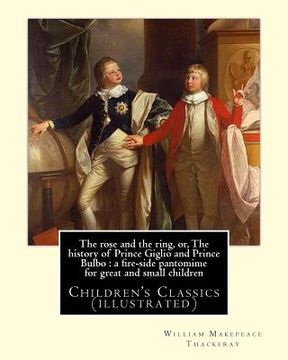
The rose and the ring, or, The history of Prince Giglio and Prince Bulbo: a fire-side pantomime for great and small children. By: William Makepeace Th (en Inglés)
Reseña del libro "The rose and the ring, or, The history of Prince Giglio and Prince Bulbo: a fire-side pantomime for great and small children. By: William Makepeace Th (en Inglés)"
The Rose and The Ring is a satirical work of fantasy fiction written by William Makepeace Thackeray, originally published at Christmas 1854 (though dated 1855).It criticises, to some extent, the attitudes of the monarchy and those at the top of society and challenges their ideals of beauty and marriage. Set in the fictional countries of Paflagonia and Crim Tartary, the story revolves around the lives and fortunes of four young royal cousins, Princesses Angelica and Rosalba, and Princes Bulbo and Giglio. Each page is headed by a line of poetry summing up the plot at that point and the storyline as a whole is laid out, as the book states, as "A Fireside Pantomime". The original edition had illustrations by Thackeray who had once intended a career as an illustrator. PLOT: The plot opens on the royal family of Paflagonia eating breakfast together: King Valoroso, his wife, the Queen, and their daughter, Princess Angelica. Through the course of the meal it is discovered that Prince Bulbo, heir to the neighbouring kingdom of Crim Tartary, and son of King Padella is coming to visit Paflagonia. It is also discovered, after the two females have left the table, that King Valoroso stole his crown, and all his wealth, from his nephew, Prince Giglio, when the prince was an infant. Prince Giglio and Princess Angelica have been brought up together very closely, Princess Angelica being considered the most beautiful and wisest girl in the kingdom and Giglio being much overlooked in the household. Giglio, besotted with his cousin, has given her a ring belonging to his mother, which, unknown to them, was given to her by the Fairy Blackstick and which held the power to make the wearer beautiful to everyone who beheld them. After an argument with Giglio, about the arrival of the long-awaited Prince Bulbo, Angelica throws the ring out of the window and can be seen for her own, less attractive self. Prince Bulbo, in his turn, possesses a magic rose, with the same power as the ring and coming from the same source: the Fairy Blackstick. Upon his arrival, this causes Angelica to be madly in love with him. Angelica's governess, Countess Gruffanuff, finds the magic ring in the garden and, whilst wearing it, convinces Giglio to sign a paper swearing to marry her. She then gives the ring to Angelica's maid, Betsinda, an orphan discovered by the family with a torn cloak in her possession. The maid, however, is actually Rosalba, the only child of the true king of Crim Tartary. When Betsinda wears the ring to take the warming pan around the bedrooms, Princes Bulbo and Giglio immediately fall in love with her, along with King Valoroso. This excites the rage of The Queen, Angelica and Gruffanuff, and causes Betsinda to be driven from the house...... William Makepeace Thackeray (18 July 1811 - 24 December 1863) was an English novelist of the 19th century.
William Makepeace Thackeray (1811-1863) fue un novelista británico, reconocido por su aguda sátira social y su retrato de la aristocracia y la clase media en la Inglaterra victoriana. Estudió en el Trinity College de Cambridge, aunque no completó su formación. Tras incursionar en el periodismo y la ilustración, se estableció como escritor con un estilo marcado por el humor y la crítica mordaz de la hipocresía social.
Entre sus obras más destacadas se encuentra La feria de las vanidades (1848), una novela de crítica social sobre la ambición y la hipocresía en la sociedad británica. También escribió Las memorias de Barry Lyndon (1844), que inspiró la película de Stanley Kubrick, y La historia de Pendennis (1848-1850), una novela de aprendizaje con tintes autobiográficos. Su legado literario lo posiciona como uno de los grandes escritores del siglo XIX.
Ver más
Ver menos