ESTE REGRESO A CLASES, ENCUENTRA MILLONES DE LIBROS CON DESCUENTO  Ver más

Enviar a
CUAUHTÉMOC, Ciudad de México
0
  • argentina
  • chile
  • colombia
  • españa
  • méxico
  • perú
  • estados unidos
  • internacional

Selecciona tu país

América

Europa

Resto del mundo

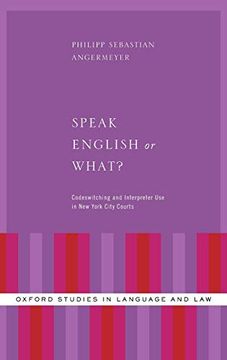
portada Speak English or What? Codeswitching and Interpreter use in new York City Courts (Oxford Studies in Language and Law) (en Inglés)
Formato
Libro Físico
Editorial
Año
2015
Idioma
Inglés
N° páginas
264
Encuadernación
Tapa Dura
ISBN13
9780199337569
N° edición
1
Categorías

Speak English or What? Codeswitching and Interpreter use in new York City Courts (Oxford Studies in Language and Law) (en Inglés)

Philipp Sebastian Angermeyer (Autor) · Oup Usa · Tapa Dura

Speak English or What? Codeswitching and Interpreter use in new York City Courts (Oxford Studies in Language and Law) (en Inglés) - Philipp Sebastian Angermeyer

Libro Nuevo Importado
Envío: 13 a 18 días háb.
$ 4,070.83$ 2,442.50
-40%
Costos de importación incluídos en el precio ✅
Libro Nuevo

Quedan más de 100 unidades

$ 2,442.50
¡Envío Gratis!  Llega entre el 20 Ago y el 28 Ago a CUAUHTÉMOC, Ciudad de México. Seleccionar ubicación

Reseña del libro "Speak English or What? Codeswitching and Interpreter use in new York City Courts (Oxford Studies in Language and Law) (en Inglés)"

This book presents a study of interpreter-mediated interaction in New York City small claims courts, drawing on audio-recorded arbitration hearings and ethnographic fieldwork. Focusing on the language use of speakers of Haitian Creole, Polish, Russian, or Spanish, the study explores how these litigants make use of their limited proficiency in English, in addition to communicating with the help of professional court interpreters. Drawing on research on courtroom interaction, legal interpreting, and conversational codeswitching, the study explores how the ability of immigrant litigants to participate in these hearings is impacted by institutional language practices and underlying language ideologies, as well as by the approaches of individual arbitrators and interpreters who vary in their willingness to accommodate to litigants and share the burden of communication with them. Litigants are shown to codeswitch between the languages in interactionally meaningful ways that facilitate communication, but such bilingual practices are found to be in conflict with court policies that habitually discourage the use of English and require litigants to act as monolinguals, using only one language throughout the entire proceedings. Moreover, the standard distribution of interpreting modes in the courtroom is shown to disadvantage litigants who rely on the interpreter, as consecutive interpreting causes their narrative testimony to be less coherent and more prone to interruptions, while simultaneous interpreting often leads to incomplete translation of legal arguments or of their opponent's testimony. Consequently, the study raises questions about the relationship between linguistic diversity and inequality, arguing that the legal system inherently privileges speakers of English.

Opiniones del libro

Preguntas frecuentes sobre el libro

Todos los libros de nuestro catálogo son Originales.
El libro está escrito en Inglés.
La encuadernación de esta edición es Tapa Dura.

Preguntas y respuestas sobre el libro

¿Tienes una pregunta sobre el libro? Inicia sesión para poder agregar tu propia pregunta.

Opiniones sobre Buscalibre

Ver más opiniones de clientes