Compartir
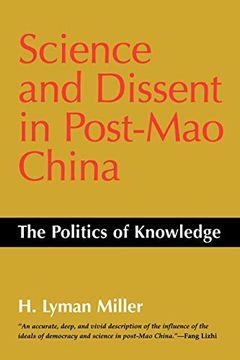
Science and Dissent in Post-Mao China: The Politics of Knowledge (Donald r. Ellegood International Publications) (en Inglés)
H. Lyman Miller (Autor)
·
University Of Washington Press
· Tapa Blanda
Science and Dissent in Post-Mao China: The Politics of Knowledge (Donald r. Ellegood International Publications) (en Inglés) - H. Lyman Miller
Libro Nuevo
Importado
Envío: 17 a 22 días háb.
$ 1,606.76$ 883.72
Costos de importación incluídos en el precio ✅
Reseña del libro "Science and Dissent in Post-Mao China: The Politics of Knowledge (Donald r. Ellegood International Publications) (en Inglés)"
When in 1989 Chinese astrophysicist Fang Lizhi sought asylum for months in the U.S. Embassy in Beijing, later escaping to the West, worldwide attention focused on the plight of liberal intellectuals in China. In Science and Dissent in Post-Mao China H. Lyman Miller examines the scientific community in China and prominent members such as Fang and physicist and historian of science Xu Liangying. Drawing on Chinese academic journals, newspapers, interviews, and correspondence with Chinese scientists, he considers the evolution of China's science policy and its impact on China's scientific community. He illuminates the professional and humanistic values that impelled scientific intellectuals on their course toward open, liberal political dissent. It is ironic that scientific dissidence in China arose in opposition to a regime supportive of and initially supported by scientists. In the late 1970s scientists were called upon to help implement reforms orchestrated by Deng Xiaoping's regime, which attached a high priority to science and technology. The regime worked to rebuild China's civilian science community and sought to enhance the standing of scientists while at the same time it continued to oppose political pluralism and suppress dissidence. The political philosophy of revolutionary China has taught generations of scientists that explanation of the entire natural world, from subatomic particles to galaxies, falls under the jurisdiction of "natural dialectics," a branch of Marxism-Leninism. Escalating debates in the 1980s questioned the relationship of Marxism to science and led some to positions of open political dissent. At issue were the autonomy of China's scientific community and the conduct of science, as well as the validity and jurisdiction of Marxist-Leninist philosophy-and hence the fundamental legitimacy of the political system itself. Miller concludes that the emergence of a renewed liberal voice in China in the 1980s was in significant part an extension into politics of what some scientists believed to be the norms of healthy science; scientific dissidence was an unintended but natural consequence of the Deng regime's reforms. This thoughtful study of science as a powerful belief system and as a source of political and social values in contemporary China will appeal to a diverse audience, including readers interested in Chinese politics and society, comparative politics, communist regimes, the political sociology of science, and the history of ideas.
- 0% (0)
- 0% (0)
- 0% (0)
- 0% (0)
- 0% (0)
Todos los libros de nuestro catálogo son Originales.
El libro está escrito en Inglés.
La encuadernación de esta edición es Tapa Blanda.
✓ Producto agregado correctamente al carro, Ir a Pagar.