ESTE REGRESO A CLASES, ENCUENTRA MILLONES DE LIBROS CON DESCUENTO   Ver más

Enviar a
CUAUHTÉMOC, Ciudad de México
0
  • argentina
  • chile
  • colombia
  • españa
  • méxico
  • perú
  • estados unidos
  • internacional

Selecciona tu país

América

Europa

Resto del mundo

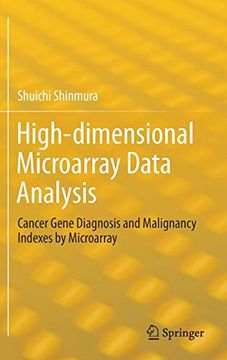
portada High-Dimensional Microarray Data Analysis: Cancer Gene Diagnosis and Malignancy Indexes by Microarray (en Inglés)
Formato
Libro Físico
Editorial
Año
2019
Idioma
Inglés
N° páginas
419
Encuadernación
Tapa Dura
ISBN13
9789811359972
N° edición
1

High-Dimensional Microarray Data Analysis: Cancer Gene Diagnosis and Malignancy Indexes by Microarray (en Inglés)

Shuichi Shinmura (Autor) · Springer · Tapa Dura

High-Dimensional Microarray Data Analysis: Cancer Gene Diagnosis and Malignancy Indexes by Microarray (en Inglés) - Shuichi Shinmura

Libro Nuevo Importado
Envío: 13 a 18 días háb.
$ 4,207.91$ 2,314.35
-45%
Costos de importación incluídos en el precio ✅
Libro Nuevo

Quedan más de 100 unidades

$ 2,314.35
¡Envío Gratis!  Llega entre el 18 Sep y el 28 Sep a CUAUHTÉMOC, Ciudad de México. Seleccionar ubicación

Reseña del libro "High-Dimensional Microarray Data Analysis: Cancer Gene Diagnosis and Malignancy Indexes by Microarray (en Inglés)"

This book shows how to decompose high-dimensional microarrays into small subspaces (Small Matryoshkas, SMs), statistically analyze them, and perform cancer gene diagnosis. The information is useful for genetic experts, anyone who analyzes genetic data, and students to use as practical textbooks.Discriminant analysis is the best approach for microarray consisting of normal and cancer classes. Microarrays are linearly separable data (LSD, Fact 3). However, because most linear discriminant function (LDF) cannot discriminate LSD theoretically and error rates are high, no one had discovered Fact 3 until now. Hard-margin SVM (H-SVM) and Revised IP-OLDF (RIP) can find Fact3 easily. LSD has the Matryoshka structure and is easily decomposed into many SMs (Fact 4).  Because all SMs are small samples and LSD, statistical methods analyze SMs easily. However, useful results cannot be obtained. On the other hand, H-SVM and RIP can discriminate two classes in SM entirely. RatioSV is the ratio of SV distance and discriminant range. The maximum RatioSVs of six microarrays is over 11.67%. This fact shows that SV separates two classes by window width (11.67%). Such easy discrimination has been unresolved since 1970. The reason is revealed by facts presented here, so this book can be read and enjoyed like a mystery novel. Many studies point out that it is difficult to separate signal and noise in a high-dimensional gene space. However, the definition of the signal is not clear. Convincing evidence is presented that LSD is a signal. Statistical analysis of the genes contained in the SM cannot provide useful information, but it shows that the discriminant score (DS) discriminated by RIP or H-SVM is easily LSD. For example, the Alon microarray has 2,000 genes which can be divided into 66 SMs. If 66 DSs are used as variables, the result is a 66-dimensional data. These signal data can be analyzed to find malignancy indicators by principal component analysis and cluster analysis.

Opiniones del libro

Preguntas frecuentes sobre el libro

Todos los libros de nuestro catálogo son Originales.
El libro está escrito en Inglés.
La encuadernación de esta edición es Tapa Dura.

Preguntas y respuestas sobre el libro

¿Tienes una pregunta sobre el libro? Inicia sesión para poder agregar tu propia pregunta.

Opiniones sobre Buscalibre

Ver más opiniones de clientes