¡CELEBREMOS A MÉXICO A LO GRANDE! CON LIBROS Y SUPER DESCUENTOS   Ver más

Enviar a
CUAUHTÉMOC, Ciudad de México
0
  • argentina
  • chile
  • colombia
  • españa
  • méxico
  • perú
  • estados unidos
  • internacional

Selecciona tu país

América

Europa

Resto del mundo

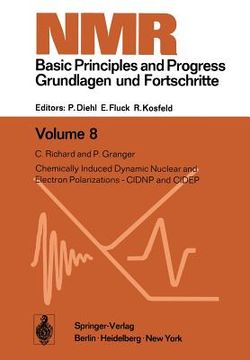
portada chemically induced dynamic nuclear and electron polarizations-cidnp and cidep (en Inglés)
Formato
Libro Físico
Editorial
Año
2011
Idioma
Inglés
N° páginas
130
Encuadernación
Tapa Blanda
Dimensiones
24.4x17x0.7 cm
Peso
0.23 kg.
ISBN
3642657958
ISBN13
9783642657955

chemically induced dynamic nuclear and electron polarizations-cidnp and cidep (en Inglés)

C. Richard (Autor) · P. Granger (Autor) · Springer · Tapa Blanda

chemically induced dynamic nuclear and electron polarizations-cidnp and cidep (en Inglés) - Richard, C. ; Granger, P.

Libro Nuevo Importado
Envío: 14 a 19 días háb.
$ 3,379.36$ 1,858.65
-45%
Costos de importación incluídos en el precio ✅
Libro Nuevo

Quedan más de 100 unidades

$ 1,858.65
¡Envío Gratis!  Llega entre el 28 Sep y el 06 Oct a CUAUHTÉMOC, Ciudad de México. Seleccionar ubicación

Reseña del libro "chemically induced dynamic nuclear and electron polarizations-cidnp and cidep (en Inglés)"

Anomalous electron-spin state populations in the Electron Paramagnetic Re- sonance (EPR) spectra of radicals formed during radio lysis experiments were observed in 1963 by FESSENDEN and SCHULER [170a]. This phenomenon did not receive much attention at the time. In 1967, BARGON, FISCHER, and JOHNSEN [5] and independently WARD and LAWLER [7,8] reported a similar phenomenon for Nuclear Magnetic Resonance (NMR) spectra taken during radical reactions: emission or enhanced absorption, or both. The earliest attempts to explain this new NMR phenomenon treated these effects in a way similar to that of Dynamic Nuclear Polarization (DNP) or the Overhauser effect. Although the polarization has a completely different origin, DNP gave its name to this effect: Chemically Induced Dynamic Nuclear Polariza- tion (CIDNP). [The name Chemically Induced Dynamic Electron Polarization (CIDEP) was introduced later by analogy with CIDNP]. After the initial publica- tions, all the new data demonstrated that the first theory could not be correct. In 1969, a new theory was proposed by CLOSS [18] and independently by KAPTEIN and OOSTERHOFF [23] and called the radical-pair theory. This mechanism was proposed to account for the observations of polarization in both NMR and EPR. The radical-pair theory is based on weak interactions in a pair of radicals: the strength of interaction between the electronic states of the radicals depends in particular on the nuclear-spin states.

Opiniones del libro

Preguntas frecuentes sobre el libro

Todos los libros de nuestro catálogo son Originales.
El libro está escrito en Inglés.
La encuadernación de esta edición es Tapa Blanda.

Preguntas y respuestas sobre el libro

¿Tienes una pregunta sobre el libro? Inicia sesión para poder agregar tu propia pregunta.

Opiniones sobre Buscalibre

Ver más opiniones de clientes