¡CELEBREMOS A MÉXICO A LO GRANDE! CON LIBROS Y SUPER DESCUENTOS   Ver más

Enviar a
CUAUHTÉMOC, Ciudad de México
0
  • argentina
  • chile
  • colombia
  • españa
  • méxico
  • perú
  • estados unidos
  • internacional

Selecciona tu país

América

Europa

Resto del mundo

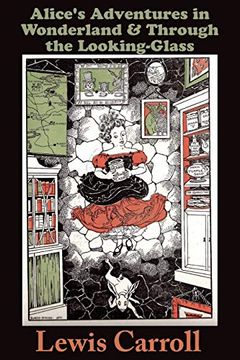
portada Alice's Adventures in Wonderland: and THROUGH THE LOOKING-GLASS and What Alice Found There (en Inglés)
Formato
Libro Físico
Idioma
Inglés
N° páginas
156
Encuadernación
Tapa Blanda
Dimensiones
22.9x15.2x0.9 cm
Peso
0.24 kg.
ISBN13
9781940849997

Alice's Adventures in Wonderland: and THROUGH THE LOOKING-GLASS and What Alice Found There (en Inglés)

Lewis Carroll (Autor) · Ancient Wisdom Publications · Tapa Blanda

Alice's Adventures in Wonderland: and THROUGH THE LOOKING-GLASS and What Alice Found There (en Inglés) - Lewis Carroll

Libro Nuevo Importado
Envío: 17 a 22 días háb.
$ 760.23$ 342.10
-55%
Costos de importación incluídos en el precio ✅
Libro Nuevo

Quedan 100 unidades

$ 342.10
Llega entre el 29 Sep y el 07 Oct a CUAUHTÉMOC, Ciudad de México. Seleccionar ubicación

Reseña del libro "Alice's Adventures in Wonderland: and THROUGH THE LOOKING-GLASS and What Alice Found There (en Inglés)"

Since Carroll was a mathematician at Christ Church, it has been suggested that there are many references and mathematical concepts in both this story and Through the Looking-Glass; examples include: In chapter 1, "Down the Rabbit-Hole", in the midst of shrinking, Alice waxes philosophic concerning what final size she will end up as, perhaps "going out altogether, like a candle"; this pondering reflects the concept of a limit. In chapter 2, "The Pool of Tears", Alice tries to perform multiplication but produces some odd results: "Let me see: four times five is twelve, and four times six is thirteen, and four times seven is--oh dear! I shall never get to twenty at that rate!" This explores the representation of numbers using different bases and positional numeral systems: 4 × 5 = 12 in base 18 notation, 4 × 6 = 13 in base 21 notation, and 4 × 7 could be 14 in base 24 notation. Continuing this sequence, going up three bases each time, the result will continue to be less than 20 in the corresponding base notation. (After 4 × 12 = 19 in Base 39, the product would be 4 × 13 = 1A in Base 42, then 1B, 1C, 1D, and so on.) In chapter 7, "A Mad Tea-Party", the March Hare, the Hatter, and the Dormouse give several examples in which the semantic value of a sentence A is not the same value of the converse of A (for example, "Why, you might just as well say that 'I see what I eat' is the same thing as 'I eat what I see'!"); in logic and mathematics, this is discussing a converse relation. Also in chapter 7, Alice ponders what it means when the changing of seats around the circular table places them back at the beginning. This is an observation of addition on the ring of integers modulo N. The Cheshire cat fades until it disappears entirely, leaving only its wide grin, suspended in the air, leading Alice to marvel and note that she has seen a cat without a grin, but never a grin without a cat. Deep abstraction of concepts, such as non-Euclidean geometry, abstract algebra, and the beginnings of mathematical logic, was taking over mathematics at the time Dodgson was writing. Dodgson's delineation of the relationship between cat and grin can be taken to represent the very concept of mathematics and number itself. For example, instead of considering two or three apples, one may easily consider the concept of 'apple', upon which the concepts of 'two' and 'three' may seem to depend. A far more sophisticated jump is to consider the concepts of 'two' and 'three' by themselves, just like a grin, originally seemingly dependent on the cat, separated conceptually from its physical object.
Lewis Carroll
  (Autor)
Ver Página del Autor
Charles Lutwidge Dodgson (Daresbury, Cheshire, Reino Unido; 27 de enero de 1832-Guildford, Surrey, Reino Unido; 14 de enero de 1898), más conocido en el mundo literario por su seudónimo Lewis Carroll fue un diácono anglicano, lógico, matemático, fotógrafo y escritor británico. Era el hijo mayor de una familia numerosa y criado en un entorno clerical, demostró desde niño una gran habilidad para las matemáticas y la narrativa, dandole la oportunidad de ingresar en Oxford, donde ejerció como profesor de matemáticas durante dos décadas.

Con el paso de los año se convirtió en un autor polifacético, cultivando su pasión por la lógica, la literatura o la fotografía, disciplinas se verían muy reflejadas en su obra literaria.

Aunque Lewis Carroll no recibió premios literarios internacionales en vida, su obra fue reconocida y celebrada desde su publicación, y su influencia ha sido duradera y global. Alicia en el país de las maravillas ha sido traducida a más de 97 idiomas y nunca ha dejado de editarse, consolidándose como un clásico imprescindible. Además, Carroll fue pionero en el uso de la lógica en la literatura infantil y en la creación de mundos fantásticos que desafían las convenciones narrativa

Sus obras más conocidas son Alicia en el país de las maravillas y su continuación, A través del espejo y lo que Alicia encontró allí, además de otras obras como la caza del snkar o Silvia y Bruno.
Ver más
Ver menos

Opiniones del libro

Preguntas frecuentes sobre el libro

Todos los libros de nuestro catálogo son Originales.
El libro está escrito en Inglés.
La encuadernación de esta edición es Tapa Blanda.

Preguntas y respuestas sobre el libro

¿Tienes una pregunta sobre el libro? Inicia sesión para poder agregar tu propia pregunta.

Opiniones sobre Buscalibre

Ver más opiniones de clientes