¡Hasta 80% descuento por nuestro Gran Aniversario!  Ver más

Enviar a
CUAUHTÉMOC, Ciudad de México
0
  • argentina
  • chile
  • colombia
  • españa
  • méxico
  • perú
  • estados unidos
  • internacional

Selecciona tu país

América

Europa

Resto del mundo

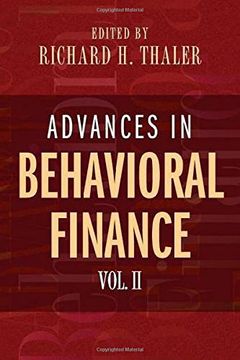
portada Advances in Behavioral Finance, Volume ii: V. 2 (The Roundtable Series in Behavioral Economics) (en Inglés)
Formato
Libro Físico
Año
2005
Idioma
Inglés
N° páginas
740
Encuadernación
Tapa Blanda
Peso
2
ISBN
0691121753
ISBN13
9780691121758

Advances in Behavioral Finance, Volume ii: V. 2 (The Roundtable Series in Behavioral Economics) (en Inglés)

Richard H. Thaler (Autor) · Princeton University Press · Tapa Blanda

Advances in Behavioral Finance, Volume ii: V. 2 (The Roundtable Series in Behavioral Economics) (en Inglés) - Richard H. Thaler

Libro Nuevo Importado
Envío: 12 a 17 días háb.
$ 3,383.52$ 1,691.76
-50%
Costos de importación incluídos en el precio ✅
Libro Nuevo

Quedan más de 100 unidades

$ 1,691.76
¡Envío Gratis!  Llega entre el 11 Sep y el 22 Sep a CUAUHTÉMOC, Ciudad de México. Seleccionar ubicación

Reseña del libro "Advances in Behavioral Finance, Volume ii: V. 2 (The Roundtable Series in Behavioral Economics) (en Inglés)"

This book offers a definitive and wide-ranging overview of developments in behavioral finance over the past ten years. In 1993, the first volume provided the standard reference to this new approach in finance--an approach that, as editor Richard Thaler put it, "entertains the possibility that some of the agents in the economy behave less than fully rationally some of the time." Much has changed since then. Not least, the bursting of the Internet bubble and the subsequent market decline further demonstrated that financial markets often fail to behave as they would if trading were truly dominated by the fully rational investors who populate financial theories. Behavioral finance has made an indelible mark on areas from asset pricing to individual investor behavior to corporate finance, and continues to see exciting empirical and theoretical advances. Advances in Behavioral Finance, Volume II constitutes the essential new resource in the field. It presents twenty recent papers by leading specialists that illustrate the abiding power of behavioral finance--of how specific departures from fully rational decision making by individual market agents can provide explanations of otherwise puzzling market phenomena. As with the first volume, it reaches beyond the world of finance to suggest, powerfully, the importance of pursuing behavioral approaches to other areas of economic life. The contributors are Brad M. Barber, Nicholas Barberis, Shlomo Benartzi, John Y. Campbell, Emil M. Dabora, Daniel Kent, François Degeorge, Kenneth A. Froot, J. B. Heaton, David Hirshleifer, Harrison Hong, Ming Huang, Narasimhan Jegadeesh, Josef Lakonishok, Owen A. Lamont, Roni Michaely, Terrance Odean, Jayendu Patel, Tano Santos, Andrei Shleifer, Robert J. Shiller, Jeremy C. Stein, Avanidhar Subrahmanyam, Richard H. Thaler, Sheridan Titman, Robert W. Vishny, Kent L. Womack, and Richard Zeckhauser.
Richard H. Thaler
  (Autor)
Ver Página del Autor
Richard H. Thaler es un economista estadounidense reconocido como uno de los principales impulsores de la economía conductual, disciplina que combina economía y psicología para estudiar cómo las personas toman decisiones reales. Nació el 12 de septiembre de 1945 en East Orange, Nueva Jersey, Estados Unidos. Estudió en la Universidad Case Western Reserve y obtuvo su doctorado en la Universidad de Rochester en 1974.

Thaler desarrolló teorías que cuestionan la idea tradicional de que los seres humanos actúan siempre de manera racional en asuntos económicos. Sus investigaciones explican fenómenos como la falta de autocontrol, la influencia de las emociones y la tendencia a valorar más aquello que ya se posee, conocido como “efecto dotación”. También popularizó la teoría del “nudge” (“empujón”), junto a Cass Sunstein, proponiendo pequeñas intervenciones para ayudar a las personas a tomar mejores decisiones sobre salud, ahorro y bienestar.

En 2017 recibió el Premio Nobel de Economía por sus contribuciones a la economía conductual. Actualmente es profesor en la University of Chicago Booth School of Business y sus libros, como Nudge y Misbehaving, han tenido gran influencia en gobiernos, empresas y políticas públicas de todo el mundo.
Ver más
Ver menos

Opiniones del libro

Preguntas frecuentes sobre el libro

Todos los libros de nuestro catálogo son Originales.
El libro está escrito en Inglés.
La encuadernación de esta edición es Tapa Blanda.

Preguntas y respuestas sobre el libro

¿Tienes una pregunta sobre el libro? Inicia sesión para poder agregar tu propia pregunta.

Opiniones sobre Buscalibre

Ver más opiniones de clientes